


11 min read
How to Choose Your Tournaments and Build Your Schedule This Summer in Las Vegas
Planning your 2026 Las Vegas poker summer? Learn how to choose the best WSOP and Vegas tournaments using structure quality, buy-in value, and smart bankroll planning.
By Stéphane
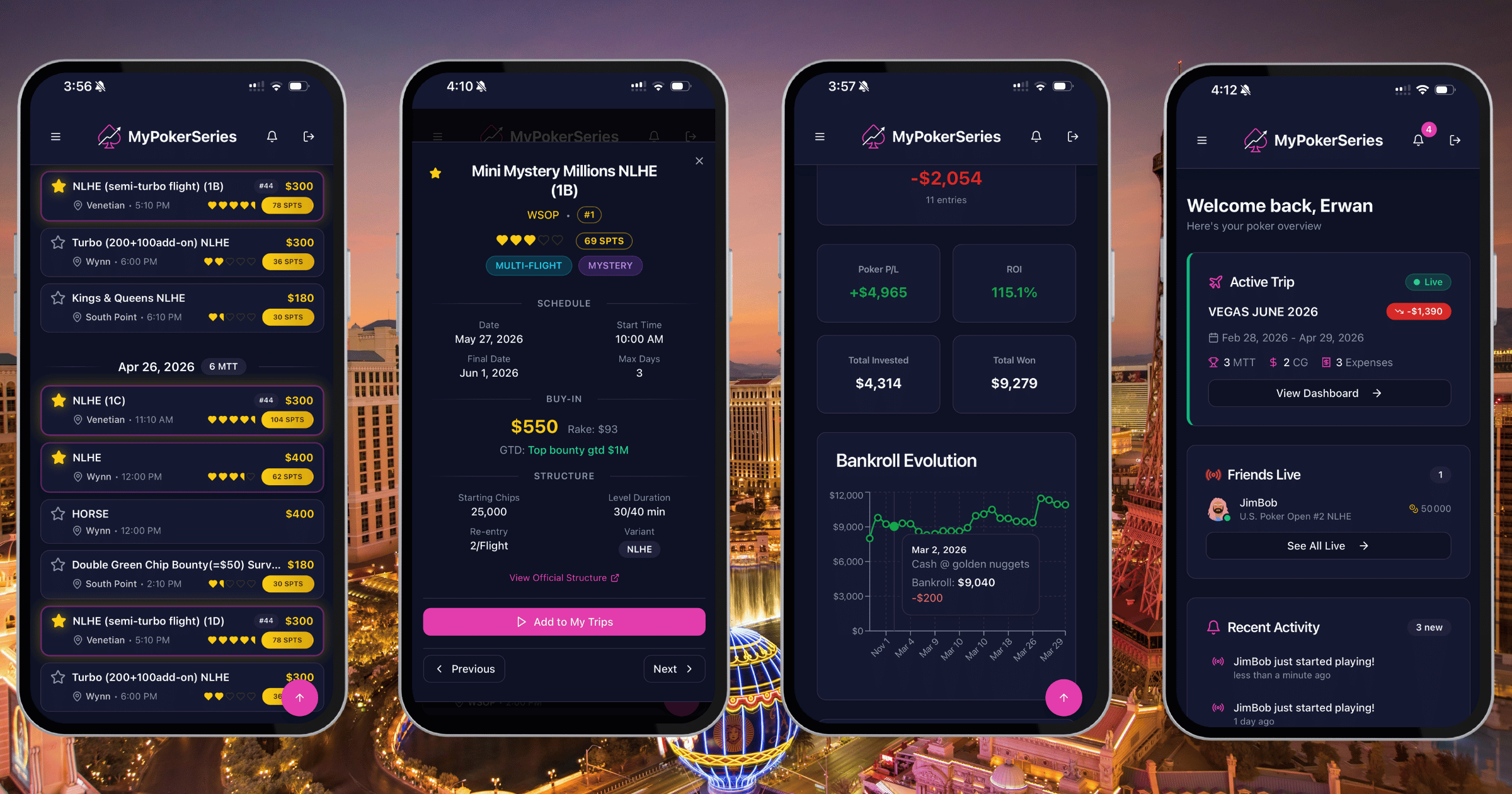
Summer 2026 — over 1,500 tournaments on the calendar. Here’s how not to get lost.
Every summer, the same story repeats itself. You arrive in Las Vegas with a more or less defined budget, a tight window of dates, and facing you: a schedule of several hundred tournaments spread across a dozen casinos, buy-ins ranging from $100 to $250,000, and formats that go from the express turbo wrapped up in three hours to the WSOP Main Event stretching nearly two weeks. Without a method, you play whatever comes up, you miss what mattered, and you head home with the vague feeling that you didn’t optimize your trip.
That’s exactly the problem we built MyPokerSeries to solve.
This article proposes a structured approach to building your schedule — based on two objective criteria: structure depth and value for money. Plus some concrete recommendations for summer 2026.
Preamble
First things first — I should clarify that this article is aimed primarily at No Limit Hold’em and PLO players. I don’t have enough expertise to discuss mixed game and variant tournaments and how to select them.
I should also note that while I rely on objective criteria most of the time, there is inevitably some subjectivity and elements that can’t be fully captured. For example, some players are die-hard Golden Nugget fans — you can prove six ways to Sunday that there are higher-quality tournaments out there, but what they love is playing at the Golden Nugget, and there’s no point arguing. Others prefer turbo tournaments, and that’s entirely their prerogative. Here I’m basing my analysis on the preferences of a player who wants to get their money’s worth — meaning that if they make a financial commitment to enter a tournament, they can reasonably expect to play for a good chunk of the day without being forced into five consecutive all-in-or-fold spots after two hours of play.
Why Tournament Structure Changes Everything
Most players choose their tournaments based on two criteria: buy-in and guarantee. Sometimes on the starting stack: “the more chips the better.” All of this is partially a mistake. The guarantee draws in the fish, sure — but if the structure is turbo, you spend most of the tournament in push-or-fold mode with 15 big blinds. Your skill edge evaporates, variance takes over, and the guarantee doesn’t compensate.
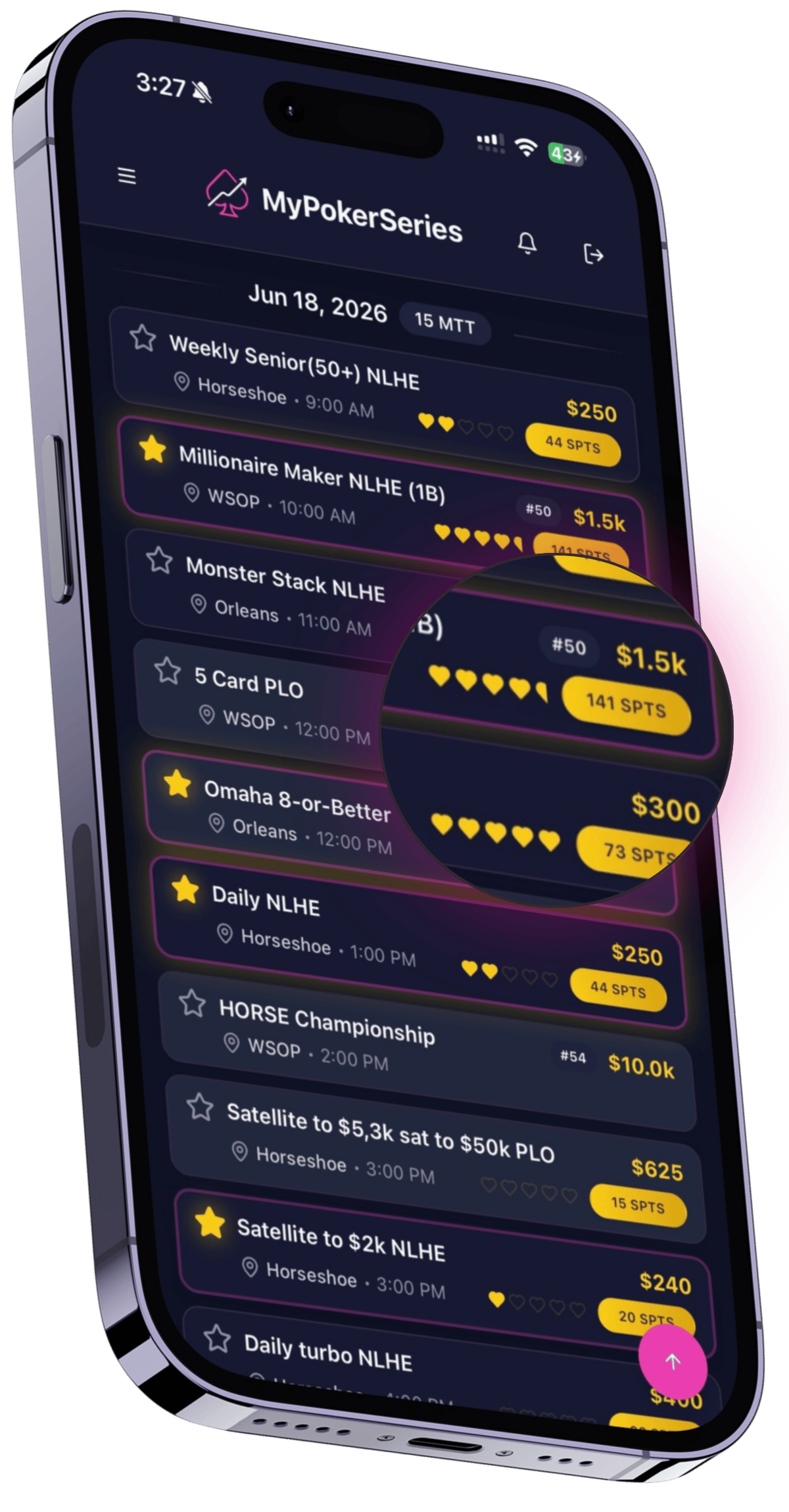
What truly determines the quality of a tournament is the number of levels and the effective playing time before you reach the critical stack-depth zones. This can be estimated through what’s known as the spts (structure points) — a composite indicator invented by “plog,” a regular on the US forum TwoPlusTwo, which accounts for level duration, starting stack depth in big blinds, and the rate at which blinds escalate.
- An spts of 30–40: fast tournament, highly random outcomes.
- An spts of 80–100: solid structure, skill genuinely matters.
- Beyond 120, you enter the territory of major reference events. The WSOP Main Event tops out at 340 — a category of its own.
But spts isn’t everything.
Factoring in the Buy-In: The Concept of Rating
An spts of 80 at $250 and an spts of 80 at $5,000 are not the same proposition at all. The first is a deep, accessible gem for almost everyone; the second is far less affordable for what is ultimately the exact same tournament experience. The rating corrects this distortion by weighting the spts against the buy-in: a tournament with a great structure and a reasonable buy-in rates higher than a structurally equivalent event that costs significantly more.
This combined indicator is what allows you to identify the real opportunities — the tournaments where you get the most “playing depth” per dollar invested.
Building Your Schedule: The Buy-In Range Method
The first step is being honest with yourself about your budget (which usually goes hand in hand with your skill level). Not the “if things go well” budget — the real budget, including likely re-entries. Once that ceiling is set, work range by range. If you’re a more modest player spending a week in Vegas with a $1,500 poker budget and you want to play every day, you’ll need to stay below $200 per buy-in. If, on the other hand, you arrive with a $10k bankroll for 10 days, you might target the $500–$1,500 range.
Keep in mind that targeting a buy-in range doesn’t mean you can never deviate. There’s nothing stopping you from mixing it up to treat yourself to a nicer event that’s slightly above budget. But whatever you do, I believe it’s essential to have already mapped out a rough schedule in advance — it’s far more comfortable and saves you two hours of deliberation every morning.
≤ $250 — The nano range: use with discretion
This range exists and has its place in a schedule — for warming up, filling slow evenings, or getting a feel for a new room. Or for players with micro bankrolls who can’t afford to step up. But structures here are generally poor. In summer 2026, the best events in this range show an spts around 45–55, which remains modest. South Point and Horseshoe dominate in volume but with structures to avoid if you’re looking for real poker. The Venetian and MGM offer a few $250 Bounty events with an spts of 55 — that’s the ceiling for this range.
Worth noting : a small gem on June 20 — a $250 ladies tournament at MGM with a very nice structure for the buy-in, though the 20% rake is excessive.
Recommended use: warm-up sessions, off days between mid-stakes events, schedule anchoring only for micro bankrolls.
$251–$500 — The richest range of the summer
This is where the real value is concentrated. The abundance of options and competition between rooms have produced an exceptionally well-stocked range in 2026. spts values range from 26 to 108!
Key events for the May–July period:
- Monster Stack NLHE Orleans at $300 (spts 73, rating 5/5): the best accessible value-for-money of the season.
- Mega Stack NLHE Orleans at $400 (spts 77, rating 5/5): same series, slightly deeper but also slightly pricier.
- Sunday Special Orleans at $300+$100 add-on (spts 81, rating 5/5): a must for Sunday — massive field, put it in your plan.
- Colossus WSOP at $500 (spts 108, rating 4.5/5): June 10. Best spts available in this range during the entire WSOP period.
- Salute to Warriors at $500, June 21, shares the same characteristics and is also a must.
- MGM also offers several solid $400 tournaments with decent structures.
$501–$1,100 — The WSOP takes over
In this range, the WSOP clearly pulls ahead. Its $1,000 events post spts values reaching 133 — the best structures available at these buy-in levels. Highlights include:
- Seniors (50+) NLHE Championship WSOP at $1,000 (spts 133, rating 5/5): June 15–16.
- Tag Team NLHE WSOP at $1,000 (spts 133, rating 5/5): June 24. Unusual format, excellent for playing as a team — which is genuinely rare in this individual game.
- Deepstack Championship NLHE WSOP at $600 (spts 104, rating 4.5/5): July 1. Best spts-per-dollar in the range.
- Ladies Mega Stack Orleans at $600 (spts 88, rating 4.5/5): June 19.
- NLHE Venetian at $800 (spts 103, rating 4.5/5): very solid if you want to stay off the WSOP schedule.
$1,100–$5,500 — Monster Stack and Millionaire Maker
If you’re playing in this range, two events stand out clearly:
- Monster Stack NLHE WSOP at $1,500 (spts 162): June 3–6. Easily the best tournament outside the Main Event. Five days of play, a massive field, and a structure that lets you actually play poker.
- Millionaire Maker NLHE WSOP at $1,500 (spts 141): June 17. Same philosophy, slightly different structure — equally a must.
These two tournaments are also worth bending your buy-in range for. They’re so good that the enjoyment factor alone is a valid reason to stretch. There are other worthwhile events in this range, virtually all from the WSOP schedule.
$5,500 and above — The Main Event and High Rollers
At this level, the spts/rating analysis still holds, but the context shifts: High Rollers at $25k–$250k feature very solid structures (spts 136–178), but the ratio isn’t exceptional — though they occupy an entirely separate category where other considerations carry significant weight.
In the world of regular human beings, the WSOP Main Event at $10,000 (spts 340, rating 5/5) stands alone — the deepest structure on the global calendar. If you have the budget and Las Vegas is part of your summer, this is a tournament you should play at least once in your life.
At the other end of the schedule, in early June, there’s a GGMillions$ at $10k with a very nice structure. It will certainly be sharper than the Main Event, which draws a large contingent of wealthy recreational players.
The Casinos: What the Data Says
Over the May–July 2026 period, the ranking by average rating is:
- MGM Grand (3.6) — schedule concentrated in June, excellent value in the $400 range
- WSOP (3.5) — better structures but higher buy-ins
- Orleans (3.4) — best value for modest bankrolls
- Venetian (2.9) over this period. A casino that runs tournaments year-round but raises its buy-ins in summer when attendance spikes, degrading structures at the lower price points. Definitely a casino to frequent outside the summer season.
- Horseshoe (0.91) — outside of WSOP events, the tournaments are only worthwhile if you want experience playing in WSOP conditions, or if you need a small supplemental event after busting a WSOP tournament without having to change casinos.
Building Your Schedule: Core Principles
Once you have the data in mind, a few practical principles for putting together a coherent plan:
- Anchor your “pillar” events in your primary buy-in range — or the special treat you want to give yourself — then fill the gaps with lower-tier events or cash game.
- Watch for overlaps: major multi-day events (Monster Stack, Millionaire Maker, Main Event) tie up several consecutive days. If you find yourself deep in one tournament when another you wanted to play starts, you need to decide in advance. And above all, avoid registering for tournaments that could conflict in date. We’ve all heard the story of the guy who makes two different Day 2s on the same day.
- Factor re-entries into your budget: a tournament with unlimited re-entry can realistically cost 2x or 3x the posted buy-in. That needs to be in your real calculation, separate from the spts. For what it’s worth, I recommend having a clear re-entry strategy locked in ahead of time and sticking to it (for example: “I don’t re-enter this tournament with fewer than 80bb”) — it prevents you from firing a re-entry 25bb deep after getting AA cracked while the tilt hasn’t subsided. Classic story, plays out all the time.
- Don’t overlook off-Strip rooms: the Orleans in particular offers some of the best structures for modest bankrolls. And the fields are reputed to be fairly soft.
- Keep flexibility built in: the best structures are generally known in advance, but on-the-ground conditions — fatigue, variance, cash game opportunities — should be allowed to adjust the plan.
Discussion
In this article, I don’t cover the Wynn, the Golden Nugget, or the Aria. I should explain: this article was written on May 5, 2026. We are two, three, and four weeks out from the start of the Wynn, Nugget, and Aria series respectively, and as of today none of the three casinos has published their structures — while every other room did so weeks ago. I won’t make any unpleasant comments, even though I have some, and I’ll instead offer a rough-cut analysis based on what we know from prior years.
The Wynn is clearly oriented toward a well-heeled clientele — single-day tournaments are crapshoot-style and expensive. If you want to play there, it’s clearly not for structure quality; other criteria would have to drive that decision. The Aria generally offers a somewhat more accessible schedule, but its buy-ins have trended sharply upward in recent years, leaving little opportunity for smaller bankrolls. The playing comfort is also debatable when you’re seated in the middle of slot machines next to a bar blasting music. At the other end of the city (and the spectrum), you have the Golden Nugget. Let’s hope the kick to the bottom of the pool will be forceful enough to wash away the disaster of the 2025 series. We need to save Private Nugget — “Saving Private Ryan.” We’ll see whether the casino bosses share that aspiration and have taken last year’s lessons to heart: if you respect players with quality tournaments, solid structures, and reasonable rake, they’ll fill your room — it really isn’t more complicated than that.
One final point I’d like to raise: this analysis covered everything on offer from May 26 through July 15 — the WSOP window. But there are tournaments before and after. And in fact, they are sometimes better. The Venetian typically offers affordable and excellent tournaments in May and late July. For the Wynn, the situation is a bit different, but the general principle — that structures are deeper outside the summer peak — holds there too.
In Summary
Choosing your tournaments in Las Vegas without a method is gambling before you even sit down at the table. Structure depth is the fundamental criterion, buy-in determines accessibility, and the ratio of the two gives you the true value of an event.
For summer 2026, the gems are found primarily in the $250–$500 range (Venetian, Orleans, WSOP Colossus) and in the $1,500 range (WSOP Monster Stack and Millionaire Maker). The rest of the schedule deserves a critical read before you commit your bankroll.
Good news: every tournament card on MyPokerSeries shows a heart rating built from this exact spts-per-dollar logic — so you can spot the gems at a glance without crunching the numbers yourself.
- WSOP
- Las Vegas Poker
- Poker Strategy
- Tournament Structures